Professional veterinary knowledge and folk wisdom in rural practice
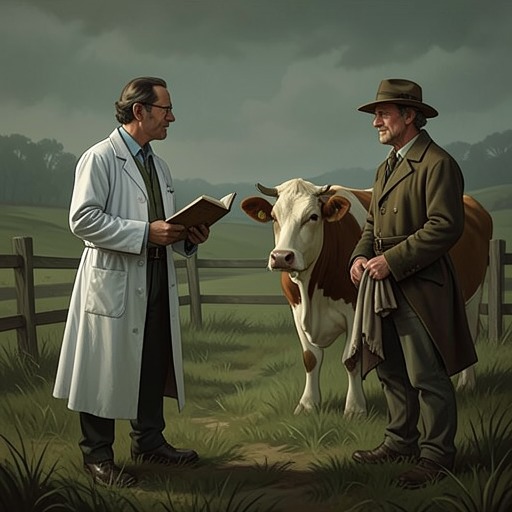
All Creatures Great and SmallProfessional veterinary knowledge and folk wisdom in rural practice are presented not as simple opposites but as competing, sometimes overlapping ways of interpreting animal illness. James Herriot’s cases place classroom learning under pressure from uncertain symptoms, limited treatments, inherited remedies, and the authority of people who have long worked with animals. The recurring tension is practical: a diagnosis must be made and an animal cared for even when neither formal expertise nor local experience offers certainty.
Training Meets the Clinic
James Herriot looks back on six months of daily work with cows, horses, pigs, dogs, and cats after five years of formal study. The clinical routine has included calving, farrowing, injuries, and exposure to the ordinary hazards of farm work, yet the accumulation of cases has not made him feel omniscient. Instead, practical experience sharpens his awareness of how much remains unknown. That humility contrasts with the confidence of people around him: farm workers, neighbors, pub-goers, and gardeners readily offer explanations and advice about sick animals.
The contrast is not simply between educated and uneducated people. Formal training has given James Herriot a framework for observing signs, considering causes, and choosing an intervention, but it does not guarantee a prompt answer. In the case of a severely distressed hunter at Lord Hulton’s estate, the horse’s condition makes ordinary belly ache an inadequate explanation. James Herriot identifies a possible intestinal torsion, then examines the horse and detects displacement and an abnormal mass. The examination strengthens the suspicion, but the available scene leaves the case unresolved. Clinical knowledge here is a disciplined process of inference, not a promise that the practitioner already knows the outcome.
The same process appears when a dog’s distended abdomen, labored breathing, and withdrawn expression point toward serious illness. The dog briefly responds to its master, but that sign does not erase the other evidence. James Herriot examines the animal rather than treating affection or appetite alone as a sufficient guide. In another case, he connects calves’ illness to the old paint on a loose board in their pen: the damaged surface and tooth marks provide a material explanation for suspected lead poisoning. Taken together, these scenes show veterinary judgment developing through attention to symptoms, examination, and the animal’s surroundings.
Remedies, Evidence, and Uncertainty
The poisoned calves also reveal how diagnosis and treatment can be more certain than the available remedy. James Herriot identifies the paint as the likely source and tells Phineas Calvert to remove the board and give the calves Epsom salts. Phineas expects a more modern intervention and questions whether this familiar treatment is enough. James Herriot explains that specific antidotes for metal poisoning are not available; magnesium sulphate is used because it can help precipitate lead as an insoluble compound. The old-fashioned-sounding remedy is not presented as proof that folk practice is always right. Rather, a practical treatment has a pharmacological rationale, even though the therapeutic options remain limited.
Phineas Calvert later turns this episode into a public judgment on veterinary medicine. At a farmers’ discussion group, after a speaker praises advances in drugs and procedures, he objects that the young veterinarian seems to rely on Epsom salts and cold water. His remark is comic, but it also registers a real gap between claims about medical progress and what a farmer sees at the point of care. From Phineas’s perspective, the treatment looks rudimentary; from the veterinarian’s, it is a constrained response to a diagnosis for which no specific antidote exists. The same intervention can therefore signify either practical competence or an apparent failure to offer something more impressive.
The case of Handshaw’s cow makes the emotional and ethical pressure of inherited remedies more explicit. After the cow remains down despite treatment for milk fever, Handshaw turns to practices attributed to his father: pouring cold water into the animal’s ear, cutting the end of its tail to cure a supposed worm, and shouting into its ear. James Herriot rejects the tail-worm explanation and objects to the cruelty of cutting the tail. He reasons instead that the cow may have posterior paralysis after the milk fever has passed, and tries a stimulant injection despite having little confidence in it. At Handshaw’s request, he also shouts into the cow’s ear; the cow pauses, then resumes chewing. The episode neither validates the inherited remedies nor allows the veterinarian to produce an immediate cure. It shows how pressure to act can draw a practitioner into trying a doubtful measure, while ethical judgment still sets limits on what he will do.
Local Authority and Professional Friction
Jeff Mallock occupies an uneasy position between veterinary practice and local expertise. His knackery serves as a rough post-mortem room where James Herriot can sometimes discover why a diagnosis failed. Farmers also send animals there after treatment to ask what had been wrong. Mallock’s opportunities to examine dead animals give him a kind of practical authority, and the farming community is ready to credit his conclusions, sometimes at the veterinarian’s expense.
Mallock cannot read or write, but he takes professional pride in his work and prefers the title fell-monger to knacker man. He believes that decades of cutting up diseased animals have taught him more than any veterinarian, and he reinforces that belief with an improvised pathology and remedies drawn from farmers he regards as more traditional. Among his supposed stock diseases are conditions with names such as stagnation of the lungs, black rot, gastric ulcers, and golf stones. His explanations can reach James Herriot through farmers who report that a case diagnosed as magnesium deficiency was actually a worm in the tail, supposedly curable by cutting off the tail. The claim persists not because the veterinarian accepts it, but because a cow may sometimes rise when the painful stump touches the ground.
That apparent success helps explain why folk explanations can survive correction: a change in the animal’s behavior may be taken as confirmation of the cause, even when the causal account is false and the procedure harmful. James Herriot finds Mallock’s interventions professionally disruptive and tries to be present when possible, especially in cases involving Isaac Cranford. Yet he does not portray Mallock as malicious. Mallock’s confidence and influence are consequential, but his desire to matter and the farmers’ respect for his experience make the conflict more complicated than a contest between a virtuous expert and a deliberate fraud.
Care Beyond Technical Knowledge
The limits of professional authority also emerge in James Herriot’s conversations with Miss Stubbs, an elderly woman whose attention is devoted to her dogs and cats. A plain card above her bed bears a religious message, while the animals’ care and companionship occupy her daily concerns. After the death of one of her dogs, she worries that she may not be reunited with her animals after death because some religious people say animals have no souls.
James Herriot answers through an ethical understanding of animal life rather than a clinical finding. He points to love, loyalty, and gratitude as qualities that matter, and tells Miss Stubbs that he believes her animals will go with her. When she asks for honesty rather than reassurance, he acknowledges uncertainty about the larger question while maintaining his personal conviction. The exchange marks an important boundary: veterinary training can inform care for animals, but it cannot establish a universal doctrine about their souls or an afterlife. The veterinarian’s response is meaningful as an act of companionship and moral regard, not as scientific proof.
Across these episodes, rural knowledge is shown to be made and tested in particular circumstances. Formal medicine contributes systematic observation and causal reasoning; farmers contribute close familiarity with animals and inherited methods; post-mortem work can expose mistakes; and neither experience nor education removes uncertainty. The difference lies partly in how claims are tested and what consequences follow from acting on them. The cases also resist a simple story of progress: in 1938, James Herriot notes, a veterinarian’s options for a cow that remains down are narrower than they would be decades later. Knowledge changes alongside its tools, while the immediate responsibility to judge, treat, and avoid needless harm remains.